Faciality
Drawing and Painting Blog, 9/25

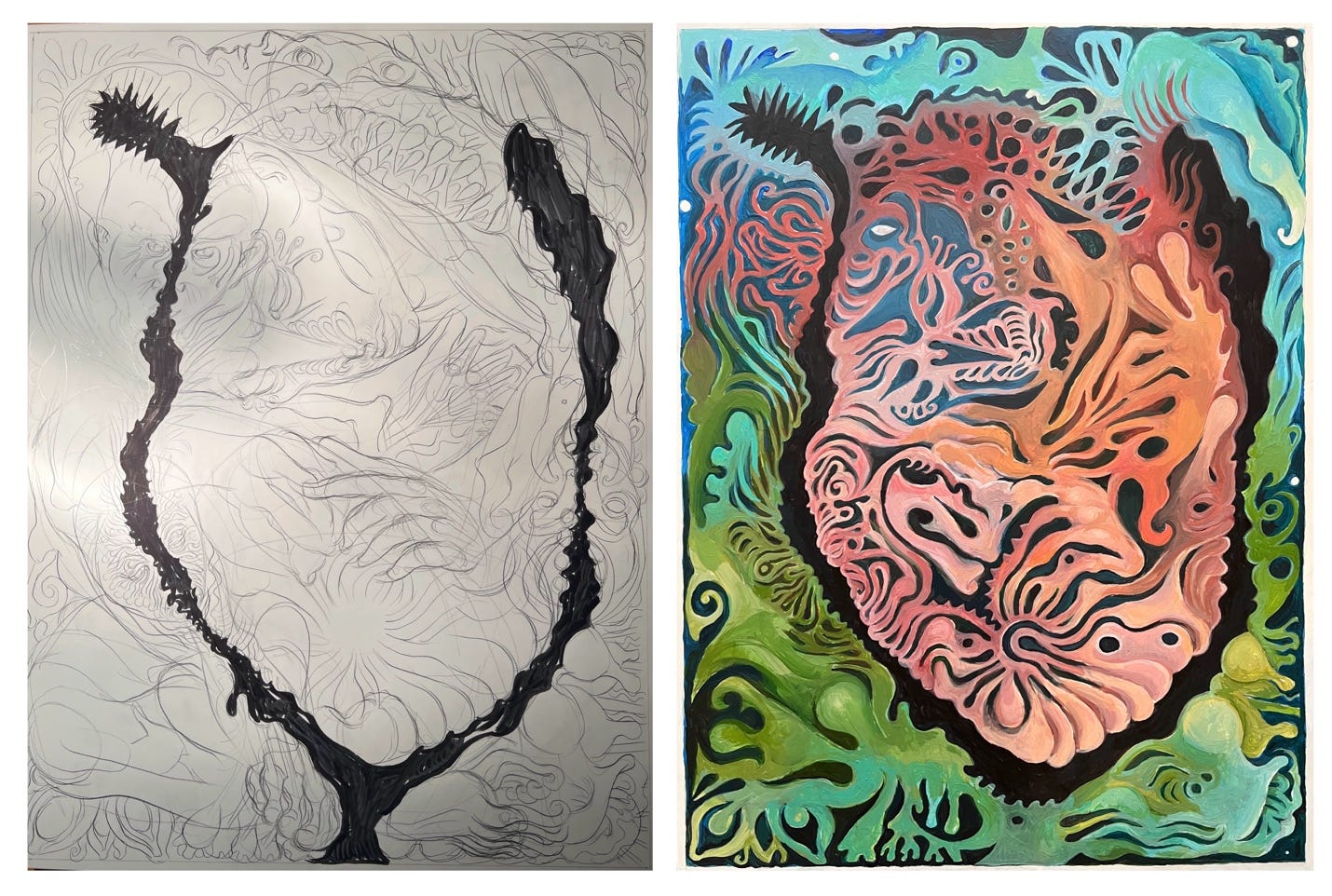
Yes, the face has a great future, but only if it is destroyed, dismantled. On the road to the asignifying and asubjective. –Deleuze and Guattari, A Thousand Plateaus, 171.
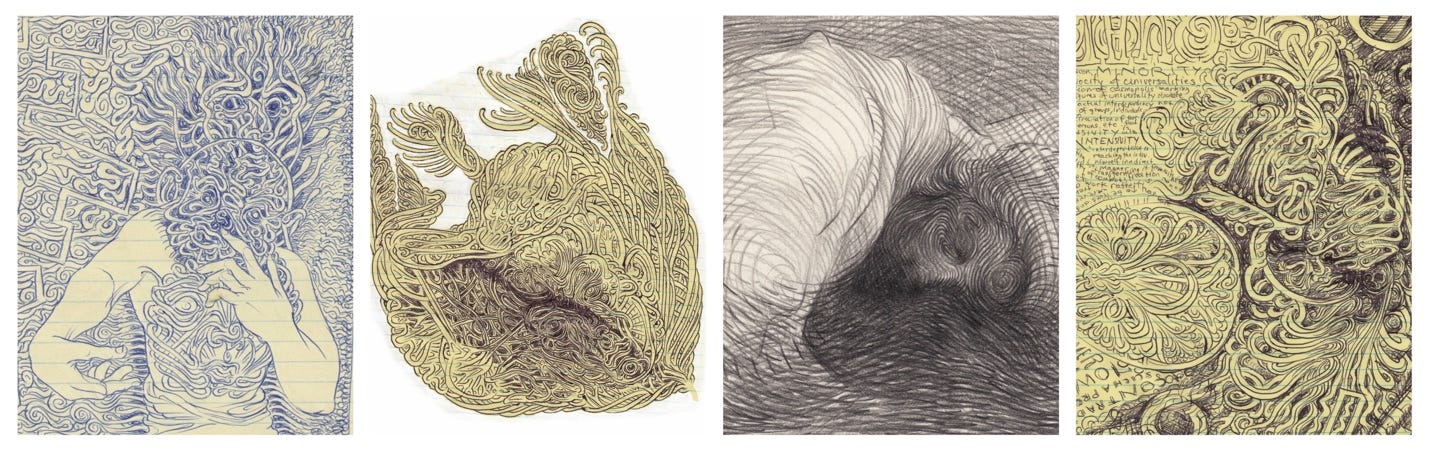
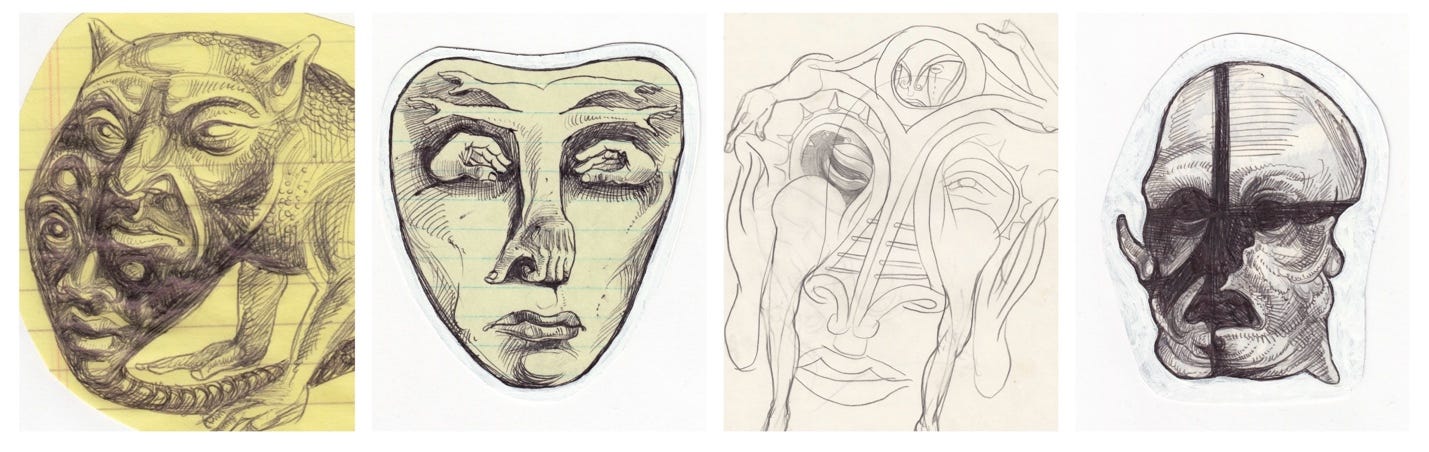
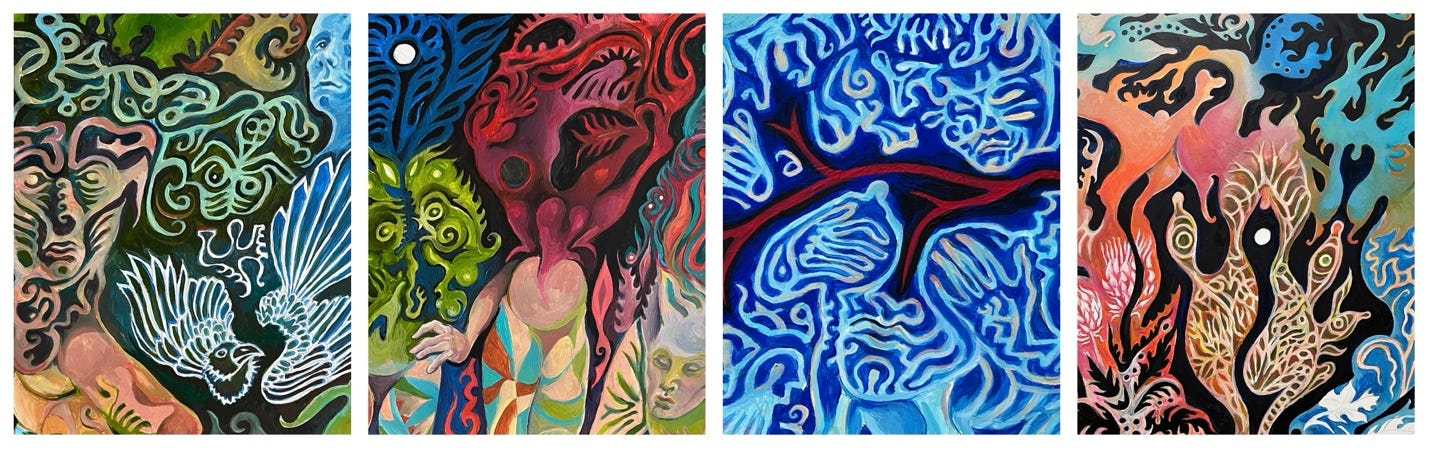
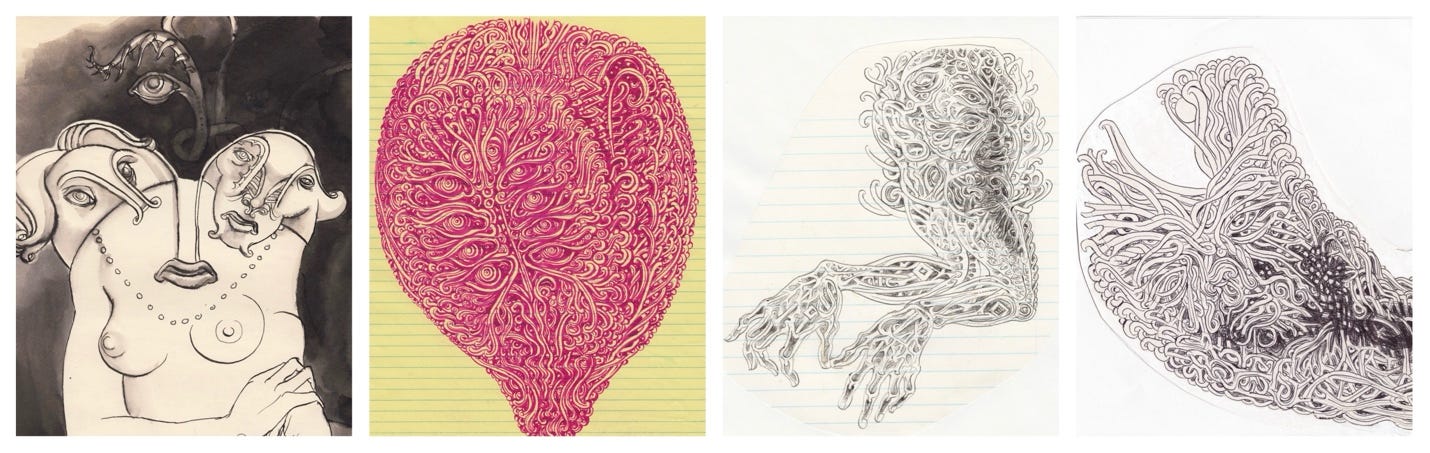
(Note: the drawings shown here—many of them details of larger images—come from the past 40 years and are in no particular order; the painting details below are from the past year. I made the painting shown above just after writing this essay, and as is often the case with me, it illustrated the essay without any intention on my part. I was wary of including the preliminary drawing with it here because it may incite the viewer to find the faces in the painting, while the thrust of the process is to lose them. I included it because, at least for me, the magic trick is compelling enough that I can show how it’s done without compromising the magic. The image doesn’t get reduced to the story that there were originally faces that got abstracted or deterritorialized. It remains, throughout, a complex ecosystem that sometimes and in some places manifests as faces. In the process of painting, the image traveled back to a time before there were faces-- to a primordial phase transition when something more or less fleshlike—a beating heart, maybe-- began to differentiate itself from its also very-much-alive and entity-like matrix.
If you don’t want to read a rambling essay, I suggest you scroll through, looking at the pictures, and maybe read the last few paragraphs, where I try to sum it up.)
1.
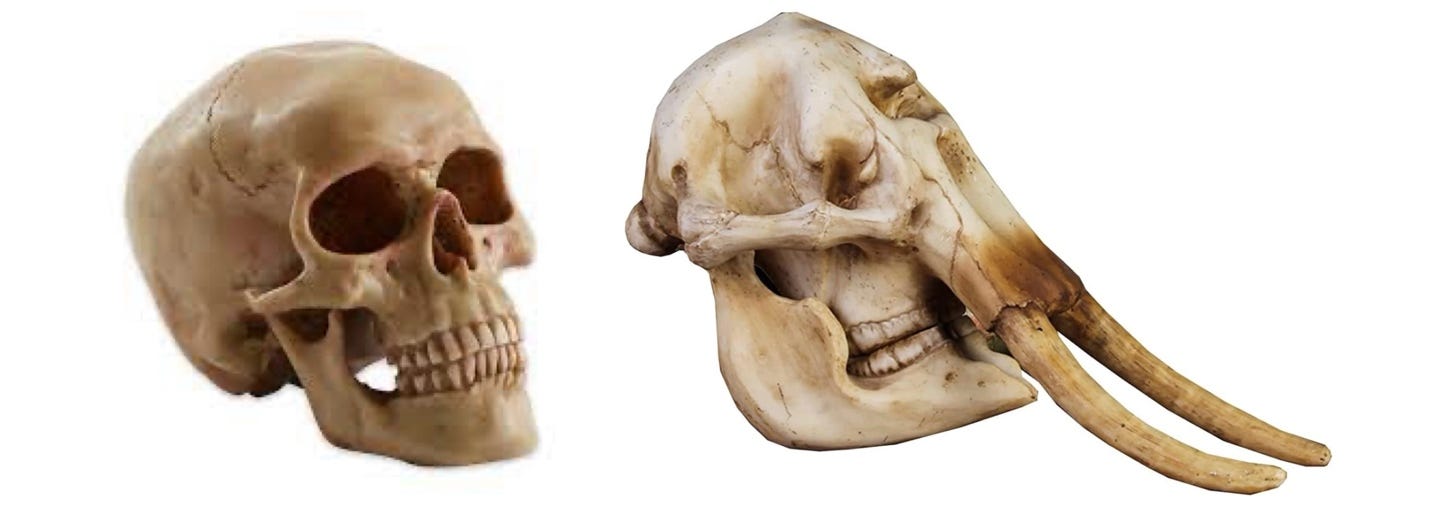
The basic structure of the face has remained constant for more than 315 million years, when our earliest semi-mammalian ancestors (synapsids) began to diverge, ever-so-slightly at first, from their reptilian kin. The standard is two eyes, and below and between them, a nose with two nostrils, and below that, a mouth—and two ears, one on each side. In fact, most reptiles had and have all of these too, with some exceptions. In spite of other radical evolutionary variations, you won’t find any mammal with three ears or nostrils, or only one eye or two mouths, or a nose on top— except for whales, whose nostrils moved to the top of their head when they returned, over millions of years, to being sea creatures. Otherwise, everything from the minimal nose of most reptiles—really just two nostrils—to the maximal nose of elephants (their trunks have two nostrils)—remains in the center of the face, between the eyes and mouth. The ears move up toward the top of the head (as in most mammals) or down the sides (as in humans), grow giant flaps (as in elephants) or reduce down to unembellished openings (as in seals) but there’s always one on each side. The snout minimizes (as in humans and some other primates) and maximizes (as in many dogs) without changing the basic position of the nose and mouth. Curiously, humans and elephants are among the few animals who have a bony chin (making an elephant skull look shockingly like a human with tusks). In any case, there are solid evolutionary reasons for both the consistencies (having two eyes enables depth perception, two ears and two nostrils allow us to ascertain the directionality of sounds and smells) and the variations (a long snout facilitates biting and fighting, if that’s your thing).
Artists—especially cartoonists-- take note: you might notice how the sites of the most variability among animals are also where you can find variability among humans. We have bigger or smaller noses, more or less protruding ears of various shapes, varying facial angles with more or less protruding jaws and chins. We can see in each other’s faces the openness of evolution, our kinship with animals of all kinds, our intimacy with otherness.
The tyranny of faces is such that the brain has a special category for them—you could say that the brain divides all visual phenomena into face and not-face-- which is why it is difficult for us to recognize even grotesque alterations in upside-down faces, which the brain doesn’t allow into its exclusive Face Club, thereby denying upside-down faces the special attention it lavishes on its members (this is known as the Thatcher Effect). We are always on the lookout for faces, often seeing them where they are not. Recognizing individual faces is much more variable, ranging from people with prosopagnosia (who can’t recognize familiar faces, usually including their own, though they have no trouble recognizing faciality as such) to super-recognizers (who can recognize thousands of faces, even of people they’ve seen only once). Although dog faces vary dramatically from breed to breed (think of a pug and a greyhound), dogs are able to recognize other dogs as dogs even from pictures of their faces.
Obviously there are evolutionary reasons for being able to recognize members of your own species (known as conspecifics), for recognizing familiar individuals, and even for having at least some sense of often-shared features of your family or lineage—though here you can begin to see the downside.
The reductive version, definitive for racism with its pseudoscientific pretensions, is that we are hardwired to recognize and to prefer members of our own race, much as we recognize members of our own family, and in each case, to serve our closest genetic kin at the expense of others. This is reductive and empirically wrong in multiple ways, but the quickest way of summarizing what’s wrong with it is by recognizing it as an exclusively endogamous or isolationist view of the world. In evolutionary terms, it might help more to recognize those who are genetically closest to you—such as members of your family—to avoid breeding with them. Diaspora, exogamy and mixing in both genetic and socio-cultural terms have always been drivers of human adaptiveness and evolution.
We are told ad nauseam that we find symmetrical faces beautiful (for the made-up reason that symmetry suggests reproductive fitness), and sometimes, that we prefer physiognomies that most resemble our own racial group, or that we prefer maximally masculine or feminine body and facial types and proportions-- even though, needless to say, ideal types vary wildly from person to person, culture to culture, and over time, even within the evolutionary eye-blink of modernity. Or to condense this down to three words, “We” who, kemosabe?
Against the eugenicism of beauty, the racism and anthropocentrism of facial recognition (or in the case of dogs, the caninocentrism), the gender normativity and binarism of body types and proportions, not to mention the ableism, thank God for the grotesque.
2.
About five years ago, I stopped drawing faces so much. This was part of a wave of abstraction that came over me, triggered by a Kandinsky exhibit and a renewal of my old teenage infatuation with his paintings—an infatuation that somehow never resulted in my drawings and paintings looking even remotely like his. This time it did-- remotely, but maybe it was just that sixty-plus years of face-dominated drawing was enough. For the first year or so, my drawings were more exclusively abstract—though tending to the biomorphic— but then they began to reincorporate somewhat more naturalistic forms-- especially flora and fauna, human bodies and faces. Still, something had changed for good.
Even now when I start drawing, it is still very often a face, usually an eye at first. My first mark on the paper is often the little c-shaped curve of the eye’s medial canthus, which is where the upper and lower lids meet on the nose side-- the little knob-like addition to the otherwise prolate spheroid (the elongated-football shape) of the open eye and the site of the lacrimal caruncle. Why start there? I don’t know. Why not? If it were female genitalia, the eyelids would be the labia and the lacrimal caruncle would be the clitoris. If it were a flower, the canthus and caruncle would be what is called the receptacle—the swelling at the end of a stem from which unfolds the bud, shaped like an eye enclosed in eyelids. This, for me, is not symbolism or surrealism. It’s just what it means to think visually in terms of shapes and their resonances.
As I am drawing a human face—this part hasn’t changed-- it may happen that the ears move towards the top of the head and get pointy, like cat’s ears; the nose, like the apex of a cathedral roof, grows flying buttresses on either side—or becomes the stem of a plant which branches out on each side into sub-stems from which sprout the eyes, like exotic flowers whose stamens are crow’s feet; the front-facing mouth splits down the middle, becoming two inward-facing mouths, which form the ends of tentacle-like sub-stems that curl out and then back towards the center line of the nose; the chin constricts into a perfect abstract sphere or circle; the brow ridges become leaves-- and all this might be the beginning of more thorough metamorphoses to come. Here is where I tend to feel I’ve just gotten to the beginning of a painting.
In the next phase, if the drawing is the first stage of a painting, things often separate and join; some become more abstract or geometrical, and some biomorphose in new ways. The buttressed nose separates from its sub-stems and becomes an almond shape while its ridge, nostrils, and buttresses become fainter internal architecture that recedes from its edges; the eyes become simplified prolate spheroids, also with faint internal structure that had been pupils, irises, eyelashes and lids-- and their stems, separated from the nose, wave and curl at the ends like flagella. The structures around them erode or self-dissect and fray and connect into a variegated network.
In the next phase, the network fragments and the fragments diversify into network-blobs, little cartoonlike dancing sprites, Ediacaran biota, a trilobite, plankton, smaller prolate spheres and teardrop shapes, some of which self-dissect further into tight little spirals. These shapes, and the slightly larger shapes of what remain of the eyes and nose, swim in a blue-blackness that suggests the depths of the sea or of outer space.
The next phase begins as a kind of tightening up. Arcs and curves and swellings and taperings are regularized to be more biomorphic or abstract or geometrical (or a mix of these), color gradations are smoothed, and maybe above all, the edges of shapes are crisped. The crisping happens via a push-and-pull negotiation between shapes and background, serving the nondualization of positive and negative space-- one of the driving forces in my painting. The blackness (whose agency in shaping has already been exercised throughout the process of push and pull) may assert itself further, opening up a rift in the field of shapes, first by swallowing the almond shape at the center (I was never completely happy with it), then an eye (since the two eyelike shapes had been imposing too much incipient faciality on the field of objects) and growing in a zig-zaggy diagonal across the field. Its own will to evolve is strong enough that it swallows not just shapes with which I was dissatisfied, but sometimes ones I loved and am sorry to lose. Occasionally (as in my triptych drawing Void Being, discussed in an earlier post on my website, iralivingston.com), it will branch out to become an ambiguous but still full-fledged entity of its own.
3.
In a Buddhist and also a psychoanalytic sense—and in common sense-- the face is a powerful representative of the ego and thus also of the symbolic order in which the ego has meaning. So the pride of place of the face is also something to question, relativize, transcend, deterritorialize.
Of course the body is not just scaffolding for a facial billboard. The face/not-face or face/body dualisms and the priority of the face are set aside in all kinds of activities—such as sports, meditation, sex, surgery. The sense of touch can democratize every square inch of the body. It levels the playing field-- as all the senses can do--even the four of them that have monopolized precious face-space for their conspicuous headquarters—though maybe not as easily or thoroughly.
But because the priority of the face is visual, deterritorializing the face and deconstructing the face/not-face duality is a project that falls to visual art in particular. For me, this means that the maximalist field of forms produced by the painting process like the one described above is radically plural, likely to include face/not-face hybrids, ambiguous faces and ambiguous not-faces, faces that evolve into landscapes or entity-scapes, or fragment and evolve into biomorphic or mechanical shapes, less ambiguous faces that live with abstract shapes and other not-facelike shapes on a level playing field, and so on. It is important for me that ambiguous faces and not-faces coexist with subliminally facelike forms, where the brain’s face recognition software might be put on yellow alert-- not quite enough to notify the conscious mind but enough to create a certain unspecifiable visual charge or interest or question; this can be what happens when what started out as a face evolves so thoroughly in the painting process as to become unrecognizable. When I say this is important to me, I don’t mean that I strive for it but that it’s the kind of thing that happens because I am looking for a leveling of the visual playing field that necessarily involves facial deterritorialization.
ASIDE: Deconstruction, Faciality, and Deterritorialization in Philosophy. The face/not-face duality is a kind of hierarchized binarity where the first term has priority, making it a prime target for the reconceptualization process known as deconstruction. Jacques Derrida, the philosopher who developed deconstruction, sometimes divided it into two phases: (1) reversal or transvaluation of the hierarchy, which here might involve prioritizing the non-facial (such as fields and systems that are not localized as faces are), and (2) displacement, which pulls the rug of binary differentiation out from under whatever has been structured by it, de-centering binarity or duality. One way of doing this is by making duality merely one kind of difference among many. It’s not enough to focus on ambiguous or hybrid faciality, because that makes it easy to recuperate the duality—for example, between ambiguous or hybrid faciality and the purely facial, or even more simply between the two components of the hybrid or the two sides of the ambiguity. This sends us back to the drawing board: how do you keep whack-a-mole duality from continuing to pop back up—or rather, since dualism is such a ubiquitous and recalcitrant kind of stuckness, how do you keep it from reappearing too easily and quickly and thoroughly? This is a question of art—that is, there isn’t an entirely formulaic answer. How much plurality will it take to swamp the binarity, to make the different kinds of difference shimmer—along with plurality and unity themselves—by not allowing any of them to dominate? In painting, this is a visual question, and when it feels like you’ve gotten there, you can call the painting finished. Of course, not everyone will see or feel this or like it or care about it, but some will find it beautiful and even sublime.
Faciality and deterritorialization were first developed as concepts by philosopher Gilles Deleuze and psychoanalyst Felix Guattari in their book A Thousand Plateaus. Faciality, for Deleuze and Guattari, is a binary structure, divided into an outer localized screen and a posited dark interiority to which the “holes” of eyes, ears, nostrils, and mouth lead. This structure organizes not just how actual faces and images of faces are conceived but ways that subjectivity or personhood is policed. Deterritorialization is the process whereby systems, components of systems, subjects, and signs are freed from frameworks or structures that have captured them and made available to be reterritorialized in more democratic assemblages. It’s too bad there’s no contemporary word for the old British term seconded, which means released from a regularly assigned position for temporary duty with another unit or organization: this is exactly how all systems obtain their raw materials—how living bodies (always temporarily) scavenge the chemicals they need to make cells, how languages selectively use sounds, and so on.
Deleuze and Guattari call the more rigid and hierarchical structures arborescent or treelike (think of a patriarchal family tree) and the more democratic structures rhizomes (which is what a family tree looks like when you cease to use fathers as the organizing principle). In addition to other kinds of organizing principles that faciality stands for, Deleuze and Guattari consider images of actual faces in film and paintings, such as in the paintings of Francis Bacon, where faces are often deterritorialized by violent torques that deform them, nullifying insides and outsides. For me, deterritorialization tends to erode, dissect, striate, fragment, and reconnect faces, integrating the reductive localization of the face into something more sprawling and systemic—a field or a network. As I understand it (and as I understand Deleuze and Guatttari’s argument), radically democratic or anarchic self-organizing is characteristic of systems of all kinds, natural and otherwise, including what I call transpainting.
I describe my own practice as maximalist, mostly because of the kind of plurality that results, but it’s easy to imagine other ways to playfully undermine the priority of the face. At this moment, I’m thinking obliquely of how an otherwise thoroughly abstract field of images might be “ruined” by the presence of a face-- not much of a maximalist strategy, but the resulting image would qualify as a member of the mixed form generally called grotesque. I think of this as akin in spirit to the tiny cartoon characters Takashi Murakami added to his blown-up screen-printed versions of Hiroshige’s 100 Famous Views of Edo woodblock prints. Murakami’s purpose was clearly not to take Hiroshige’s landscapes down a peg; his Hiroshiges are reverential. The cartoon figures restore the sense of the world as a magical and beautiful place that Hiroshige delivered in the first place, which for Murakami (as for me) means a place inhabited by joyful creatures of all kinds that could not possibly be rendered in any single, unified genre.
The project of facial deterritorialization, in the deepest sense, then, may be part of transcending or at least relativizing the ego, and the range of other ethical and even sensual improvements that this involves. The problems with the ego are also the problems with recognition. The problems are hard to see because recognition is almost always used in an exclusively positive sense—as in seeing someone else less as a screen for projections (yours and theirs) and more compassionately for the full range of who they are, and in a more explicitly ethical and political sense, seeing the other as a fellow human. These are noble principles, but unfortunately, recognizing humanity—like faciality in general—usually also involves a kind of belonging that is exclusionary, just as the “search for recognition” necessarily involves a normative and hierarchical symbolic social order that works to control what can be recognized and what cannot.
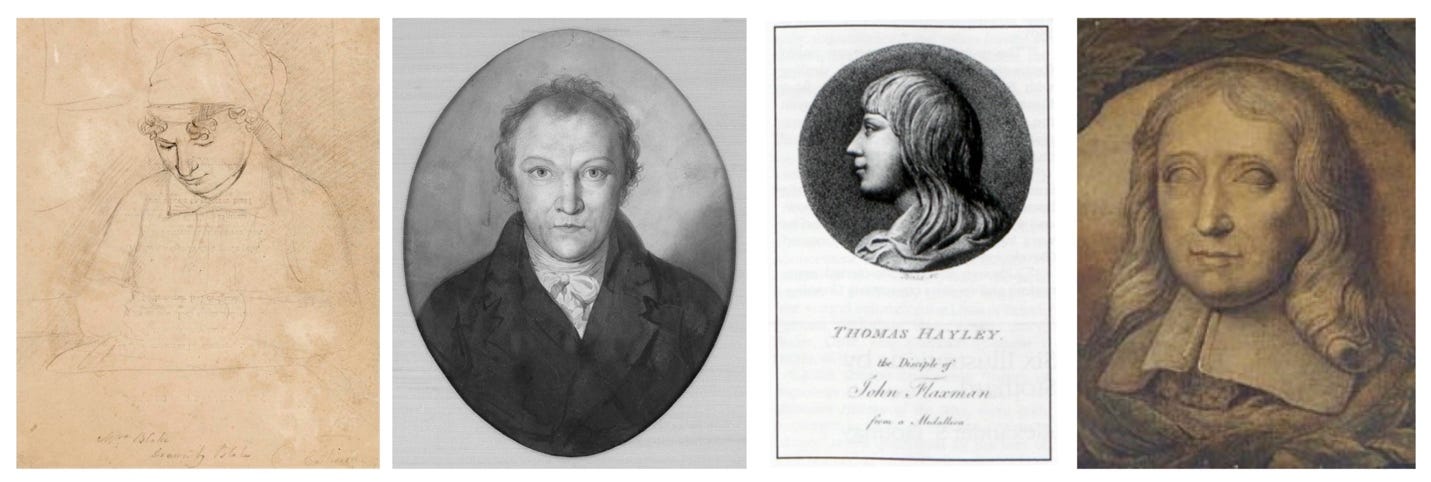
I am an erratic portraitist—which means I get individual likeness/recognition right only every now and then. This used to be a source of some shame for me—not much, but some—and occasionally I’ve found it frustrating, but I learned from William Blake how to transvalue my failings as a portraitist. Blake was also an erratic portraitist; among his thousands of drawings and prints, I know of only one lovely portrait done from life in a realistic style—an impromptu portrait of his wife Catherine. All the others I’ve seen are weird—such as his single realistic self portrait-- and often not in a good way. William Hayley, Blake’s sometime patron, tried to push him to make a living by painting portraits—especially in miniature-- of well-to-do clients. In fact, it’d be hard to come up with a more diabolical way of torturing him. But Blake gave it his best shot. His apologies about his art and writings are usually backhanded, but I find poignant the matter-of-factness of one of his letters to Hayley in which he refers to his portrait of Hayley’s departed son Thomas: “hope the likeness is improved. The lip I have again lessened as you advised.”
See below (1) Blake’s impromptu portrait of Catherine, (2) his only realistic or semi-realistic self portrait, (3) his engraving of Thomas Hayley (which Blake did from a medallion) and (4) his portrait of Milton (also commissioned by Hayley and clearly done to look like the sculpted bust or medallion it came from). Apologies to Blake for including here only his most unrepresentative work.
As Blake put it elsewhere, “the eagle never lost so much time as when he submitted to learn of the crow.” He came to realize that portrait painting went against the grain of his fundamental temperamental, aesthetic, political, spiritual, intellectual, and class orientations. Or you could just say he sucked at it. The point—the one that helps me know myself better and more compassionately-- is that the latter is often a reflection of the former.
Along this line, I have sometimes been struck by people saying “I don’t understand” something without realizing that it means something more like “I fundamentally disagree with or disapprove of some aspect of it” or more generously “I guess I’m just from another planet” or less generously “I fucking hate it.” I felt something like this about the systems theory of Niklas Luhmann, which was formative for me even though some part of it remained frustratingly opaque-- until I realized what it was about the theory that fundamentally disagreed with me and made it indigestible. In the process, I also learned how you can gain profound insights from something that you regard as fundamentally wrong—positive insights, not just those stemming from disagreements.
Other than assorted occasions when I’ve done portraits or caricatures, likeness or individual recognition isn’t even on my radar. My faces are generic—but so are many of the faces on classical Greek statues, dolls, fetishes, talismans and so on. Sometimes it’s important to me that a face be beautiful or weird or serene—or that it not be goofy or mean-looking—but for the most part, I’m also uninterested in making it expressive. More often than not, I’m not even thinking of making it masculine or feminine, so many of the faces I draw are more or less androgynous. And I often don’t paint the iris and pupil of the eye—as in classical statues, masks, and Chinese dragons—and as in most of the portraits by Amedeo Modigliani, who is supposed to have said “when I know your soul, I’ll paint your eyes.”
Though the above describes my practice for about 60 years, this is the first time I’ve put it into words. One of the reasons I think it’s worth saying is that, even though it’s easy to reject realism, it’s harder to reject individual facial recognizability and expressivity-- and harder still to say what else it is you might care about instead—the point of this essay, which I’m about to condense into a short paragraph.
The point is not simply to deface or demote the face as such but to raise everything visual up to face level, to invest everything with the kind of attention, immediacy, and cathexis-- careful, loving, charged, anxious, resonant (with the sense of kinship)-- that we otherwise extend only to faces. For me, this is about cultivating visual kinship with the faceless and the ecosystematic in its looping and sprawling multiplicity and unity.
Isn’t this, in some sense, the project of visual art?
Or if you want the Kabbalistic version, as Blake put it,
The cherub with his flaming sword is hereby commanded to leave his guard at [the] tree of life, and when he does, the whole creation will be consumed and appear infinite and holy, whereas it now appears finite and corrupt. This will come to pass by an improvement of sensual enjoyment.
Geneva, 2025
(Note: The Thomas Hayley portrait is from an article by Jenijoy La Belle, who discovered a reprint of it in an out-of-the-way antiquarian book from 1887. See her article “A Reprinting of Blake’s Portrait of Thomas Alphonso Hayley” in Blake: An Illustrated Quarterly, Vol. 25, Issue 3; Winter 1991/1992, 136-38; online at https://bq.blakearchive.org/25.3.labelle
Hi, I loved your essay and description of the problems as an artist you face to create portraits as per the accepted genre of portraiture. I like the term faciality but I can’t fully understand what D and G wish us to make of it. I am not an artist but a wordsmith (poet, writer and essayist). The question which troubles me more is: why depiction of human or living beings are considered to be portraits and that of a lake, mountain, ocean, or a tree aren’t. Is this because of the binary opposition of nature and culture, quite alien to indigenous practices, or there are other philosophical, sociological, and cultural factors. I would love to hear from you.
Thanks for your essay,
Subhash Jaireth
https://sjaireth.substack.com/p/philia-friendship